
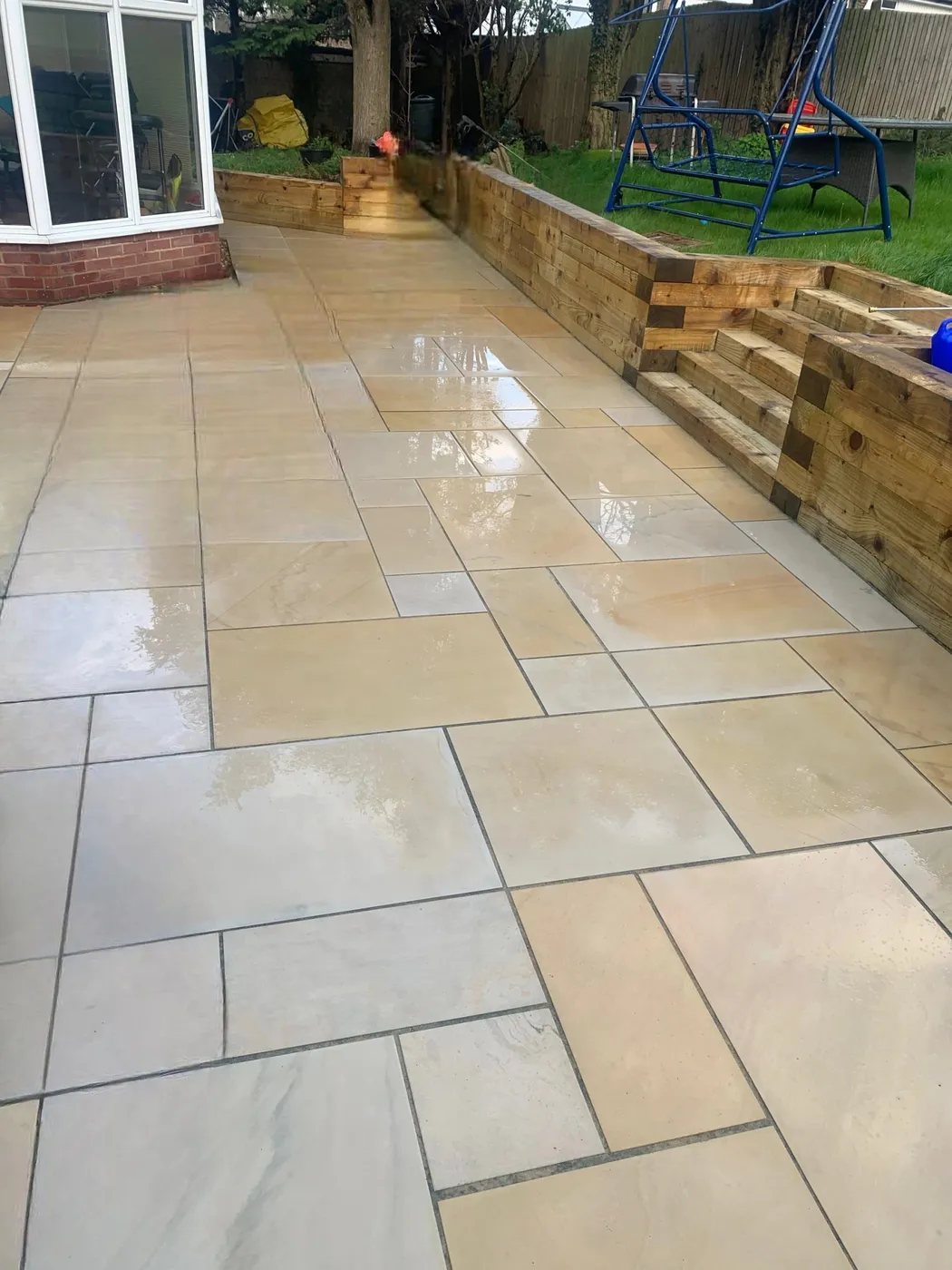
The short answer is that those stubborn black spots are not dirt, they are a living organism called lichen, and the only reliable way to remove them is to treat the surface with a biocide that kills the growth at root level, then let it break down and wash away. Jet washing on its own will not do it, and neither will bleach or an ordinary patio cleaner. If the marks keep coming back within a few months of cleaning, this is almost always the reason. Below I will explain what black spot lichen is, why the usual methods fail, what is safe on your type of paving, and how to keep it from returning.
What black spot lichen actually is
Lichen is an unusual thing. It is not a single plant but two organisms living together: an alga that makes energy from sunlight, and a fungus that anchors the whole thing to the stone. That fungal part is the reason black spots are such a nuisance. It sends tiny root-like threads, called hyphae, down into the pores of your paving, so the black mark you can see on the surface is only the top of something growing deep into the slab.
You will usually see it as small, flat, tar-like black dots, often no bigger than a five pence piece, scattered across block paving, natural stone or concrete. It grows slowly, it clings hard, and it favours damp, shaded spots. Here in Surrey we see a lot of it on north-facing patios and driveways that sit under trees or beside a fence, where the surface rarely gets a chance to fully dry out.
Why jet washing, bleach and patio cleaner keep failing
This is the part that catches most people out. A pressure washer cleans the surface, and for a week or two the patio looks great. But the roots are still sitting in the stone, untouched, so the black spots quietly grow back. Within a few months you are looking at the same problem you started with.
Worse, high-pressure washing can make things return faster. Blasting natural stone or concrete roughens the surface and opens up the pores, which gives lichen spores even more places to take hold next time. On block paving it also strips out the kiln-dried sand from the joints, which then need re-sanding to lock the blocks back together.
Bleach and off-the-shelf patio cleaners have the same weakness. They lighten the black colour on the surface, so it looks like they have worked, but they do not reach the fungus at the root. Once the bleach fades the spots come back. Household bleach is also mildly acidic, which is bad news on softer natural stones like sandstone and limestone, because it can eat into the minerals and leave the surface more porous than before. In short, most methods treat the mark, not the thing making the mark.
The method that actually works: soft washing with a biocide
To clear black spots properly you have to kill the lichen where it lives, and that means a biocide rather than raw water pressure. This is what the trade calls soft washing. Instead of relying on force, we apply a treatment that soaks into the stone, kills the growth including the roots, and then breaks it down so it can be rinsed or weathered away.
In practice a good result usually comes from two stages. First, a low-pressure clean to lift the loose surface dirt, algae and any moss, so the treatment can reach the lichen rather than sitting on top of grime. Then a biocide is applied and left to do its work. Products used for spot removal tend to be based on sodium hypochlorite, while longer-lasting spray-and-leave treatments often use a quaternary biocide such as DDAC that keeps protecting the surface after the visible growth has gone. You can read more about how we approach this on our soft washing page.
One thing worth being honest about: this is not always an instant transformation. The biocide starts killing the growth within the hour, but the staining fades over time as the dead lichen breaks down and the weather washes it away. Lighter green algae can disappear within a week or so, while old, deeply set black spots can take several weeks and occasionally a few months, sometimes needing a second treatment. It is slower than a jet wash, but unlike a jet wash it lasts.
What is safe on your type of paving
Different surfaces need very different handling, and getting this wrong is how patios get permanently damaged. Here is the short version for the materials we see most often:
- Block paving: reasonably tough, but the joints are the weak point. Aggressive pressure blows out the kiln-dried sand, so it should be cleaned with care and then re-sanded. A biocide is the real fix for the black spots themselves.
- Indian sandstone and other natural stone: soft and porous, so this is the surface most easily damaged by a pressure washer. It should be treated at low pressure with a wide fan nozzle, or ideally soft washed, and never blasted at close range or straight into the joints.
- Porcelain: hard-wearing and low porosity, so it resists staining well and cleans up nicely, but the grout joints still need a gentle approach.
- Concrete and imprinted concrete: tolerant of cleaning, but the sealer on patterned concrete can be stripped by high pressure, so a soft wash is safer and keeps the finish intact.
- Resin-bound surfaces: these rarely need a pressure wash at all. A gentle rinse and the right treatment handles most growth, and heavy blasting can loosen the resin.
If you are unsure what you have, the safest rule is to start gentle and never test full pressure on the main area. The cost of stripping a sandstone surface or wrecking your jointing sand is a lot more than the cost of cleaning it properly, so when in doubt it is worth getting a professional to look at it. Our patio cleaning and driveway cleaning pages explain how we tailor the approach to the surface.
How to stop it coming back
Because lichen thrives in damp and shade, prevention is really about changing the conditions it likes. The Royal Horticultural Society makes the same point: growths return if the environment stays the same, so the aim is to keep the surface drier and lighter. A few practical things help a lot:
- Cut back overhanging branches and shrubs to let in more light and air, so the surface dries out faster after rain.
- Keep the paving swept and clear of leaves and debris, which trap moisture and feed new growth.
- Make sure water drains away properly and does not pool, and keep any drainage channels clear.
- Consider a spray-and-leave protective biocide once the surface is clean, which slows re-colonisation for many months.
- On porous natural stone, a suitable sealer can reduce how easily spores get a grip, though it needs redoing periodically.
None of this makes a patio maintenance-free, especially in a shaded Surrey garden, but it stretches the gap between cleans considerably. A light annual treatment is far easier than letting the black spots take hold again.
Frequently asked questions
Will a pressure washer remove black spots from my patio?
Not properly. A pressure washer cleans the surface and the patio looks better for a week or two, but the lichen roots stay in the stone and the black spots grow back. It can also roughen the surface and blow out jointing sand, which sometimes makes the problem return faster. You need a biocide to kill the growth at the root.
How long does it take for the black spots to disappear after treatment?
The biocide starts killing the lichen within the hour, but the staining fades gradually as the dead growth breaks down and weathers away. Lighter marks can clear within a week or so, while old, deeply set black spots may take several weeks, sometimes needing a second application.
Is bleach a safe way to remove lichen from paving?
It is not a good idea. Bleach lightens the colour on the surface so it looks like it worked, but it does not reach the roots, so the spots return. It is also mildly acidic, which can damage softer natural stones such as sandstone and limestone and leave them more porous than before.
Can black spots be removed from Indian sandstone without damaging it?
Yes, but not with high pressure. Sandstone is soft and porous, so it is best soft washed with a biocide, or cleaned at low pressure with a wide fan nozzle kept well back from the joints. Blasting it at close range can pit the surface and strip out the jointing.