For the vast majority of UK roofs, soft washing is the safe method and high pressure jet washing is the one to avoid. A jet wash blasts the tiles clean in minutes, but it also strips the protective surface off concrete tiles, can crack or dislodge older tiles, and forces water up under the laps where it does not belong. Soft washing does the opposite. It uses a gentle, low pressure application of a biocide that kills the moss and algae at the root and keeps working long after we have packed up.
That is the short answer. If you want to understand why, and where the rare exceptions sit, here is the full picture from someone who cleans roofs across Surrey, Sussex and Kent every week.
Why moss and algae take hold in the first place
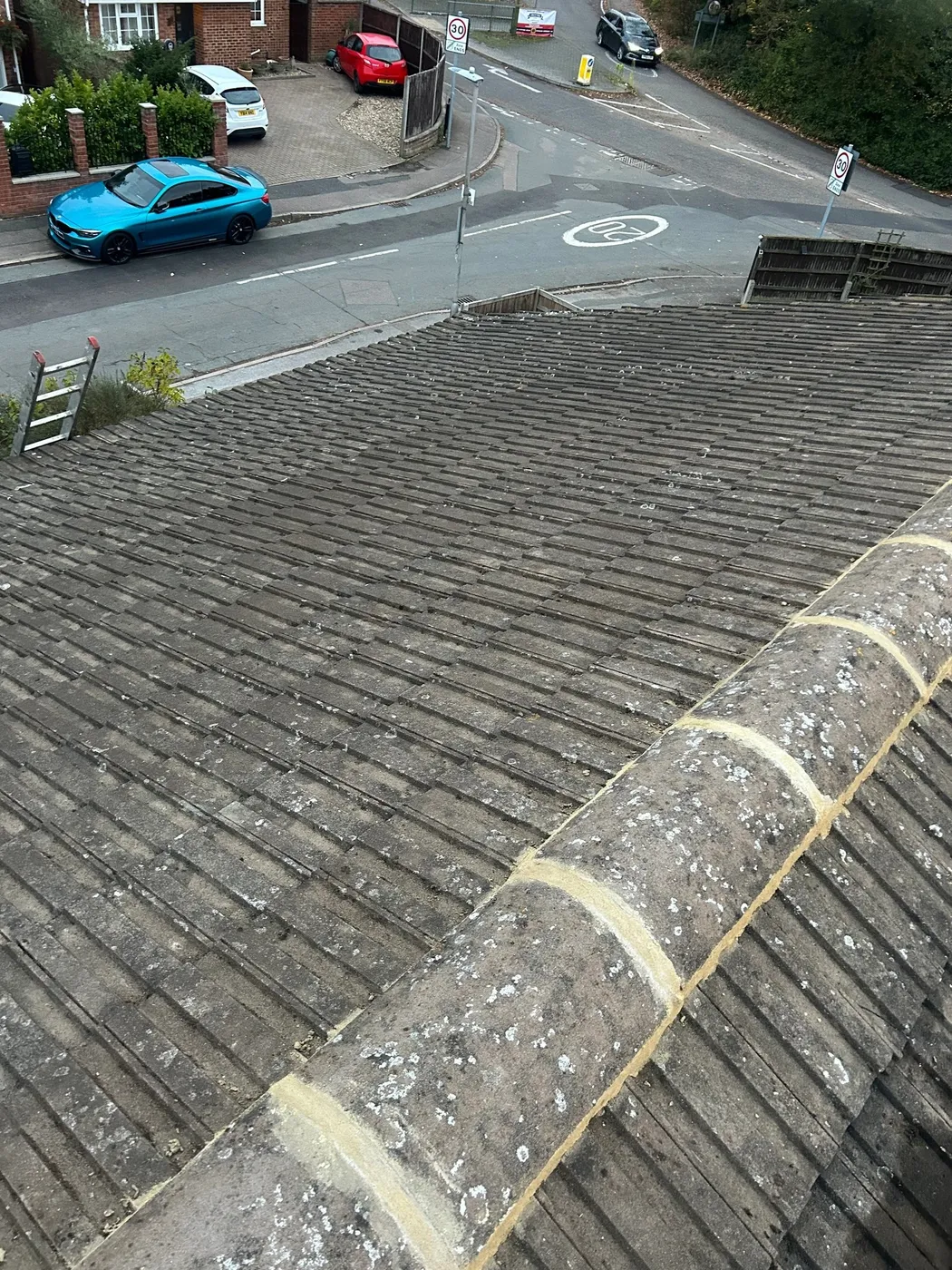
Moss, algae and lichen all want the same thing: damp and shade. A north facing slope holds moisture for longer because the sun never really dries it out, so that is almost always the greenest side of any roof. Add overhanging trees, a bit of poor drainage or a sheltered spot, and you have ideal growing conditions. Around here that is very common. Plenty of homes in leafy parts of Surrey and the Sussex and Kent borders sit under mature trees, and those roofs green up far quicker than an exposed one on open ground.
It helps to know what you are actually dealing with, because they behave differently:
- Algae shows as green or black staining and streaks. It is the earliest, most common growth and it feeds on the tile surface.
- Moss is the thick, velvety green cushioning you can see from the ground. It traps water against the tile and blocks gutters and valleys as it breaks off.
- Lichen is the crusty, flat, often pale patches. It is the stubborn one. It roots deep into the tile surface and cannot be pulled off without taking some of the tile with it.
The important part is that what you can see is only part of the problem. Most growth starts as spores that are far too small to notice, sitting on and just under the tile surface. Scraping the visible moss off does nothing about the spores, which is why a roof that has only been scraped greens back up so quickly.
What high pressure washing actually does to a roof
A jet wash looks impressive because it makes the tiles bright again in one pass. The damage is what you do not see from the driveway. Most UK roofs are concrete tile, and a concrete tile has a fine granular finish on its exposed face. That surface is designed to weather away very slowly over the life of the tile, which is usually many decades. A high pressure lance tears that layer off in seconds.
Once the protective face is gone, the raw concrete underneath is exposed and far more porous. It holds water and organic matter more readily, so ironically the moss comes back faster and thicker than before. That is the trap with jet washing: the roof looks its best the day it is done and worse than ever a couple of years later. On top of that, the pressure itself can chip and crack tiles, knock them out of position, and drive water up under the overlaps and past the felt into the loft space.
This is not just our opinion as cleaners. The tile manufacturers say the same thing. Marley, one of the largest UK tile makers, states plainly that the use of high powered jet washes is not recommended as it can damage the surface of the slate or tile, reducing its expected life considerably. The Roof Tile Association, which speaks for manufacturers including Marley, Redland and Sandtoft, advises that if growth must be removed physically it should be done with a low pressure water spray of only around 4 to 5 bar, never a high pressure jet. Many roofing guarantees are void the moment a roof is jet washed.
What soft washing is and why it is the safe choice
Soft washing is a low pressure method. Instead of relying on force, it relies on the right treatment. We clear any heavy moss by hand first, then apply a specialist biocide across the whole roof at low pressure. The biocide soaks into the surface and kills the algae, moss and lichen at the root, including the spores you cannot see. There is no blasting and no stripping of the tile finish, so the roof is left intact.
The other advantage is that a biocide keeps working after the visit. It bonds to the tile, and every time it rains a small controlled amount is released that continues to kill off new spores as they try to establish. So the roof carries on improving over the following weeks and months rather than being at its best on day one and downhill from there. It is worth being honest about the timescale: soft washing is not instant. Heavy staining and dead moss lighten and wash away gradually over the weeks after treatment, which is normal and exactly how it should work.
You can read more about how we approach this on our roof cleaning and soft washing pages.
Does it depend on your roof type?
The tile type changes the detail, but the answer stays the same across all of them: keep the pressure off.
- Concrete tile, the most common UK roof, has that granular surface that high pressure ruins. Soft washing protects it.
- Clay tile is porous and can crack or chip under pressure, so a gentle biocide treatment is the sensible route.
- Natural slate is smooth, which means moss mostly gathers in the joints rather than across the face, but slate is brittle and a jet wash can fracture it. Low pressure and biocide again.
In short, there is no common UK roof that benefits from being jet washed. If anything, the older and more fragile the roof, the more important it is to stay gentle.
Safety, access and doing it properly
Cleaning a roof means working at height, which is where most of the real risk sits. It needs proper access, whether that is a tower, scaffold or a powered platform, and it needs someone comfortable and insured to be up there. That is a large part of why roof cleaning is a job worth handing over rather than tackling off a domestic ladder. While we are up there we will usually check and clear the gutters too, since a roof full of moss almost always means gutters full of it as well. You can see what that involves on our gutter clearing page.
Frequently asked questions
Will pressure washing damage my roof tiles?
On most UK roofs, yes. High pressure strips the protective granular surface off concrete tiles, can crack or dislodge tiles, and can force water under the laps into the loft. Tile manufacturers such as Marley advise against it, and it can void your roofing guarantee. Soft washing avoids all of this.
How long does soft washing take to work?
It is not instant, and that is normal. The biocide kills the growth at the root and the roof then clears gradually over the following weeks and months as the dead moss and staining wash away with the rain. The treatment also keeps working, releasing a little more each time it rains.
Is soft washing safe for older or slate roofs?
Yes, and it is the preferred method precisely because those roofs are more fragile. Slate is brittle and clay can chip, so a gentle low pressure biocide treatment is far safer than any form of jet washing.
How often should a roof in Surrey be cleaned?
It depends on shade and tree cover more than anything. A north facing or heavily shaded roof under trees, which is common locally, will green up faster than an exposed one. A good soft wash keeps a roof clear for several years, and we are happy to take a look and give you an honest view. Get in touch for a quote.