There is no single best month, and none of the official guidance gives one. Moss is often greener and more noticeable through the colder, wetter months, so this guide's reading is that the two useful windows are autumn and spring, picked for a dry spell with no rain forecast for as long as your product label asks. Brushing and scraping clears moss the same day. A treatment takes longer, and the dead growth then has to weather or brush away.
Last checked on 13 October 2026. Product pages and water company rules change, so read the label on the pack you actually buy, and the current notice from the company named on your water bill, before you start.
When is the best time of year to kill moss on a driveway?
The Royal Horticultural Society's guidance on moss and algae on hard surfaces does not name a month, and neither do the Health and Safety Executive's pages on garden products. What decides the timing is how moss lives and what the product label asks for.
The Woodland Trust explains that moss 'needs water to survive and reproduce', so it tends to grow in 'damp, shady places', and that it is often 'greener and more noticeable during these colder, wetter months'. The article was published in January, so it is talking about winter. This guide's reading is that moss stands out most through the cooler, wetter half of the year.
The labels say the same thing about weather. Patio Magic's ready to use spray says 'Treat in dry weather, when no rain is expected for 24 hours after treatment' and 'For best results, apply when surface is completely dry.' Wet and Forget, which is sold for mould, lichen and algae rather than moss, says not to apply it if rain is expected within 4 to 5 hours. The windows differ by product, so follow your own label. The forecast matters more than the calendar.
Why do the guides disagree?
Search for the best time to kill moss on a driveway and the pages near the top give late spring and early autumn, spring or autumn, and even summer. Most do not say where their answer comes from. No official body sets a month, which leaves each guide to pick its own. The RHS does put moss work on lawns in its autumn advice, but that is about scarifying grass, not about paving, so it does not carry across to a drive.
Autumn and spring are two different jobs
An autumn job is about getting ahead of the wet months: clear or treat the moss in a dry spell before winter. The RHS notes that algae build-ups on hard surfaces 'often occur after wet winters', and that many mosses favour damp conditions too. A spring job is a full clean of whatever the winter left behind, which is why our guide on how often to clean a driveway or patio calls spring the natural time for it.
Why does moss grow on tarmac and driveways?
The RHS says 'Many mosses favour damp, shady conditions', and that mosses are often found in shady corners and in the spaces between paving. Pavingexpert says moss turns up on pavements 'where detritus and debris has been allowed to accumulate'. On a driveway that means the edges, the joints, any cracks, the strip under a hedge or tree, and the patch beside the house that the sun never reaches.
Moss has no true roots. The RHS describes mosses as having 'shallow rhizoids that anchor them to a surface', and says their airborne spores 'can travel many miles'. Pavingexpert adds that moss tends not to penetrate paving, but sits 'atop the crud that has been allowed to accumulate on and around the paving'.
The RHS says these growths 'do not damage the surfaces they grow on'. The real problems are looks and grip, because they 'can make surfaces slippery'. On a sloping drive in a wet winter, that is the reason to deal with it.
The RHS describes common mosses as 'Compact, green, cushion-like', while lichens on paving and stone form 'thin, flat crusts'. Lichen is a different problem with a different fix, covered in our guide to removing black spots and lichen from a patio or driveway.
What kills moss on driveways and tarmac?
Removing moss and killing it are different jobs. Removing moss with a brush, a scraper or water clears it now. Killing it with a treatment takes longer, and the dead growth then weathers or brushes off. Neither is permanent. The RHS says growths 'will return to an area if the growing conditions remain unchanged', and that 'Most products are non-persistent and repeat applications will be required.'
Brushing and scraping
The RHS advice is simple: 'Brush hard surfaces with a stiff broom or wire brush to remove established growths', and 'Use a pointed weeding tool, or old knife, to remove mosses from the cracks between paving.' It goes further than most guides: 'As non-chemical control methods are effective, there is no need to use mosskillers or chemical patio cleaners.'
Shop-bought moss killers for tarmac: read the label
The HSE says 'The control of moss is regulated under the GB and EU Plant Protection Products Regulations (GB PPPR and EU PPPR).' Its garden guidance says these products 'must be authorised or permitted before they can be marketed or used in the UK', and 'Always use PPPs as instructed on the label.' The RHS confirms that products for home gardeners are available for use legally. So before you buy a moss killer for a tarmac drive, check that the label on the pack names moss and names tarmac.
Brand pages and product pages do not always match. Patio Magic's ready to use product page says it 'Kills mould, algae and lichens' and lists 'tarmac and asphalt driveways' among its surfaces, but the word moss does not appear on it. The Patio Magic brand page says its no-rinse formula 'clears moss, algae, green mould, and lichen from hard surfaces'. Wet and Forget's 2 litre page names mould, lichen, algae and black spots, does not mention moss, and lists driveways including block paving, but not tarmac.
Jeyes says its fluid 'can help remove moss and algae from hard outdoor surfaces like patios and decking when used regularly', and its FAQ page says nothing about tarmac. There is more on it in our guide to whether Jeyes Fluid removes patio black spots. One more warning from Pavingexpert: iron (ferrous) sulphate products 'can also re-colour the paving to a less than fetching shade of orange'.
Homemade moss killers: vinegar, washing powder and bleach
None of the official guidance cited here recommends vinegar, washing powder, bleach or any other homemade mix on a drive. The RHS says that as non-chemical methods are effective, there is no need to use mosskillers at all. The HSE says it is aware that some gardeners use home-made remedies, but warns that this does not mean using common household chemicals this way 'is without risk or that it is always legal'. It adds that supplying a home-made remedy to someone else may fall within the regulations, and would then be illegal without an authorisation. Pavingexpert, a paving trade site rather than an official body, takes a different view: it suggests a bleach wash-down, alongside regular brushing, to help keep moss from coming back. This guide still gives no recipes, because of the HSE warning above.
How do you get moss off tarmac without damaging it?
Barratt's aftercare advice for tarmac drives is careful about scraping, pressure and spills, and the same care applies to moss. A sensible order of work:
- Wait for a dry spell, with no rain forecast for as long as your product label says.
- Sweep the drive with a stiff broom, then work a pointed weeding tool along the edges and cracks, as the RHS suggests.
- Scrape gently and do not dig. Barratt's tarmac advice is to 'very gently scrape away the weed, being careful not to disturb the surface itself' and 'Do not pull out any roots, as this could damage the surfacing'. It is written about weeds, but the same care protects the surface from a heavy-handed scraper.
- If you treat it, use a product whose label names tarmac, and follow that label. Patio Magic says to keep pets and wildlife off treated surfaces until dry, and 'Do not allow any run-off into fish-tanks or ponds'.
- Leave it for the time the label gives. For example, Patio Magic's spray, whose product page lists mould, algae and lichens rather than moss, says 'Visible results within 3 days depending on the severity of growth and weather conditions'.
- Brush off the dead growth once it has died back.
- Never tip leftover product down a drain. The HSE says 'Never pour PPPs down the drain, toilet or sink', because of the risk of contaminating water and harming wildlife.
GOV.UK guidance says 'Surface water drains discharge directly to the environment', and Mid Sussex District Council describes surface water drains as carrying rainwater only. If your drive drains into a surface water drain, nothing but clean water should go into it.
Should you pressure wash moss off tarmac?
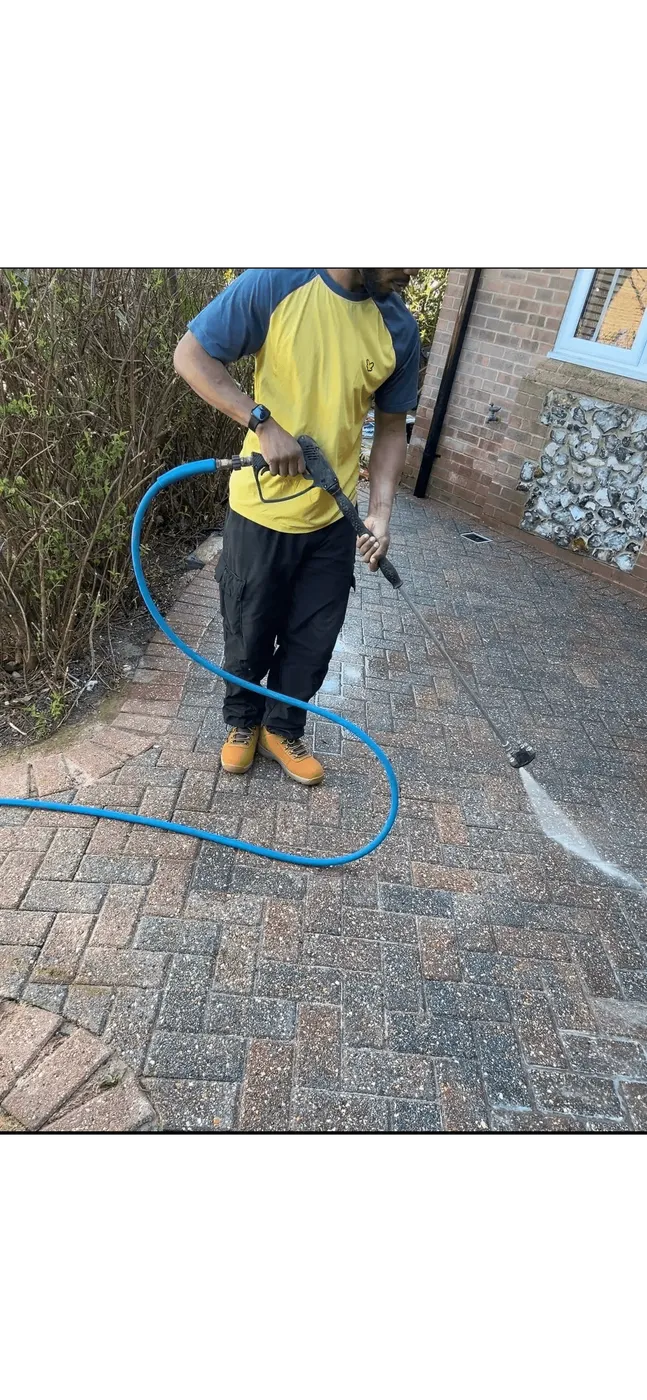
The RHS says 'Use a pressure washer to remove growths quickly', to use it 'with care in areas where drainage is unsatisfactory', and to 'Always wear goggles when using a pressure washer'. It also points out that 'a lot of water and energy will be used for just a temporary solution'. On tarmac, Barratt adds a specific warning: 'The use of pressure washers on your driveway is not recommended during its early life-span as this will force out the fine aggregates.' It also says fuel and oil spills 'have a corrosive effect on the bitumen', so keep fuel and oil off the surface.
This autumn there is also the water question. As of 13 October 2026, Thames Water says 'A temporary use ban (TUB) remains in place', and its restrictions page lists cleaning patios, driveways and paths with a hosepipe or pressure washer among the things customers must not do. South East Water says it brought in a hosepipe ban (Temporary Use Ban) for household customers in Kent, Sussex, Berkshire, Surrey and Hampshire in July. Its FAQ says the ban 'restricts using a hosepipe to clean walls, windows, paths, patios and other artificial outdoor surfaces of domestic properties, unless it is for unavoidable health and safety reasons'. It also removed its previous ban exemptions in Sussex from 9 October 2026, including 'commercial hosepipe cleaning for domestic properties', except for health, safety and animal welfare purposes. It has also applied for a wider Non Essential Use Ban for Sussex, which it says 'is currently an application only'. SES Water says it is 'not planning to introduce a hosepipe ban at this stage'. A broom and a scraper need no water at all.
If you would rather hand the job to a professional, our driveway cleaning service removes dirt, moss, algae and stains from block paving, concrete and paved driveways. If your drive is tarmac, say so when you ask, so the right approach can be agreed before anything starts.
Block paving and concrete: what changes?
Block paving
On block paving, moss lives in the joints, where debris collects. That is also where the risk sits when it is washed. Pavingexpert warns that power washing can damage a pavement 'especially if the high-pressure water jet is allowed to remove that critical jointing material', and Marshalls says 'the sand needs to be replaced before any substantial traffic is allowed on the driveway'. Our guides on whether pressure washing damages block paving and what sand to use after jet washing block paving cover both in detail.
Concrete
To get rid of moss on concrete, use the same RHS methods set out above. Brush the surface with a stiff broom or wire brush, and work a pointed weeding tool or old knife along the cracks and joints. Pavingexpert says 'Most moss can be removed by sweeping and/or scraping.' If you use a pressure washer, the RHS says to take care where drainage is poor and to always wear goggles.
For any driveway that has been washed, Marshalls' general advice is 'Let the driveway air dry completely before allowing vehicles or foot traffic on it.' Concrete is one of the surfaces our driveway cleaning service names, alongside block paving and paved driveways.
How do you stop moss coming back on a driveway?
Because moss returns whenever the conditions stay the same, prevention means changing the conditions. The RHS list is short and practical:
- 'Prune overhanging plants to reduce shading and improve air flow', so the drive dries faster after rain.
- 'Ensure surfaces slope slightly to prevent standing water.'
- 'Keep drains clear of leaves and debris', so rainwater runs away quickly.
- Brush regularly. The RHS says 'Brushing on a regular basis helps to prevent growths from taking hold.'
Getting your driveway cleaned before winter
We are based in Horley and clean driveways across Surrey, Sussex and Kent. If you would like moss and grime cleared before the wet months, call or WhatsApp 07504685871, or ask for a free, no-obligation quote. Whether a pressure washer can be used at your home this autumn depends on your water company, which is named on your bill, so tell us who supplies your water when you get in touch.
For what a driveway clean typically costs, our guide to driveway cleaning costs in the UK sets out the published price ranges, and the driveway cleaning page explains how a clean is approached.
Frequently asked questions
Does Patio Magic kill moss?
The maker's pages say two different things. Patio Magic's ready to use product page says it kills mould, algae and lichens and does not mention moss, while the Patio Magic brand page says its no-rinse formula clears moss, algae, green mould and lichen from hard surfaces. Both were checked on 13 October 2026. Read the label on the pack you buy and check it names moss and your surface.
Does washing powder kill moss on tarmac?
None of the official guidance cited here recommends it. The HSE warns that using common household chemicals as a plant protection product is not necessarily without risk, and not always legal. The HSE also says the control of moss is regulated under the plant protection products rules. Whatever you use, keep it out of surface water drains, which carry rainwater straight to the environment.
What kills moss the fastest?
Physical removal. The RHS says a stiff broom or wire brush removes established growths, and a pointed weeding tool clears the cracks, so the moss is gone the same day. Treatments are slower. As an example, Patio Magic's spray says visible results within 3 days, though its product page lists mould, algae and lichens, not moss, so check your own label for moss and its timing.
Is Jeyes Fluid good for moss on tarmac?
Jeyes says its fluid can help remove moss and algae from hard outdoor surfaces like patios and decking when used regularly, and that you should always refer to the label for dilution. Its FAQ page says nothing about tarmac, so check the label before using it on a tarmac drive.
Does moss damage a tarmac driveway?
The RHS says moss, algae and lichens do not damage the surfaces they grow on. The real risk is that they make hard surfaces slippery, which matters most on a sloping drive or path in winter.